An app built in an AI assistant has no identity of its own. Helix gives every app enterprise SSO, managed credentials, and scoped role-based access the moment it deploys.
Your private status link is on its way to your inbox.
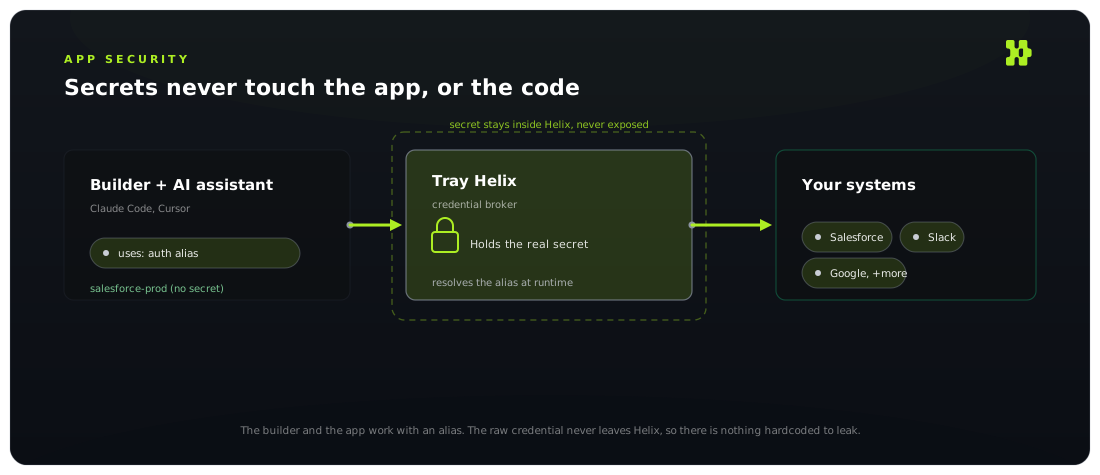
An app built in an AI assistant is good at doing the job and silent on who may use it. It has no front door, no scoped access, and whatever credential handling the builder improvised to reach a third-party system. App Security closes that gap at the deploy path: every Helix app inherits enterprise SSO and role-based access, reaches your systems through managed auth aliases rather than pasted keys, and carries an audit trail from its first request.
AI assistants are good at writing working code. They are not the thing that decides who may open the app or which systems it may reach.
A vibe-coded app ships with whatever auth the builder improvised, which usually means a shared link and an honour system.
To reach Salesforce or Slack, a builder pastes a key. It lands in a repo, a config file, or a prompt, and it outlives the app.
Every app arrives as a bespoke case with no owner, no access list, and no log. Reviews take weeks because the answers have to be reconstructed.
When something goes wrong, nobody can say quickly which systems the app could reach or whose data it touched.
Every app inherits your identity provider from its first request. There is no per-app login for a builder to invent and no shared link standing in for authentication.
Access is granted at org, workspace, or individual level, with workspace roles of Admin, Contributor, and Read-only, so scope is explicit rather than assumed.
Connect to Salesforce, Google Sheets, Slack, and the rest of the supported list through auth aliases resolved at runtime, rather than a key pasted into the code.
The builder and the AI assistant never see a raw credential, so there is nothing in the repo, the config, the environment, or the prompt to leak later.
A record for org admins of who was granted access to which projects and when, produced as a by-product of how access works rather than a separate log to wire up.
Apps run in the US as standard, and EU or APAC residency is available through Sovereign Cloud, so where the app runs is a decision rather than an accident.
An app built in an AI assistant arrives with no front door and whatever credential handling the builder improvised. Helix gives every app enterprise identity, managed auth, and scoped access the moment it deploys.
A vibe-coded app has no identity story of its own, and that gap is exactly what IT fears. Helix closes it at deploy rather than asking the builder to solve it.
Secret scanners find credentials after they are committed. Managed auth means the credential never enters the code in the first place, so there is nothing to find.
Security becomes a property of the platform rather than of whoever built the app, so the tenth app is as well defended as the first.
Each app arrives with scoped access, a named owner, and a trail already in place, so a review is a check rather than an investigation.
The app connects through a managed auth alias. No API key exists in the repository, and revoking access is a change in one place rather than a code change.
The reviewer opens the app and finds the owner, the access list, the connections, and the audit trail already there, in the same shape as every other app.
When the person who built an app changes team, their access goes with the identity change and the app keeps running under its named owner.
A team dashboard gets read access to the two systems it reads from, rather than a credential that happens to carry far more permission than the app uses.
For any app, the access record shows which people and groups were granted access and when, without emailing round to reconstruct it.
An app built by a contractor runs behind your SSO with scoped access, so their departure does not leave a credential behind in someone's config.
Managed auth is the easier path. Reaching Salesforce or Slack through an auth alias takes less work than finding, pasting, and later rotating a key, so the secure route is also the convenient one.
No. Credentials are resolved by the platform at runtime, outside the app's code. The builder and the AI both work against an alias, so neither handles the secret.
No. Apps inherit your existing enterprise SSO, so people sign in the way they already do everywhere else.
Your org needs Tray enabled and the auth created in Tray. Once it exists, apps reference it as an alias rather than holding the credential.
It records who was granted access to which projects and when, and every app run is logged with 30-day retention. That covers the access and activity questions a review usually opens with.
See what an app looks like when identity, managed auth, and an audit trail attach before it goes live.
Your private status link is on its way to your inbox.