Apps deployed through Helix land in the registry automatically, each with a named owner. IT gets a live inventory of what is running, and the people cleared to use an app can find and open it.
Your private status link is on its way to your inbox.
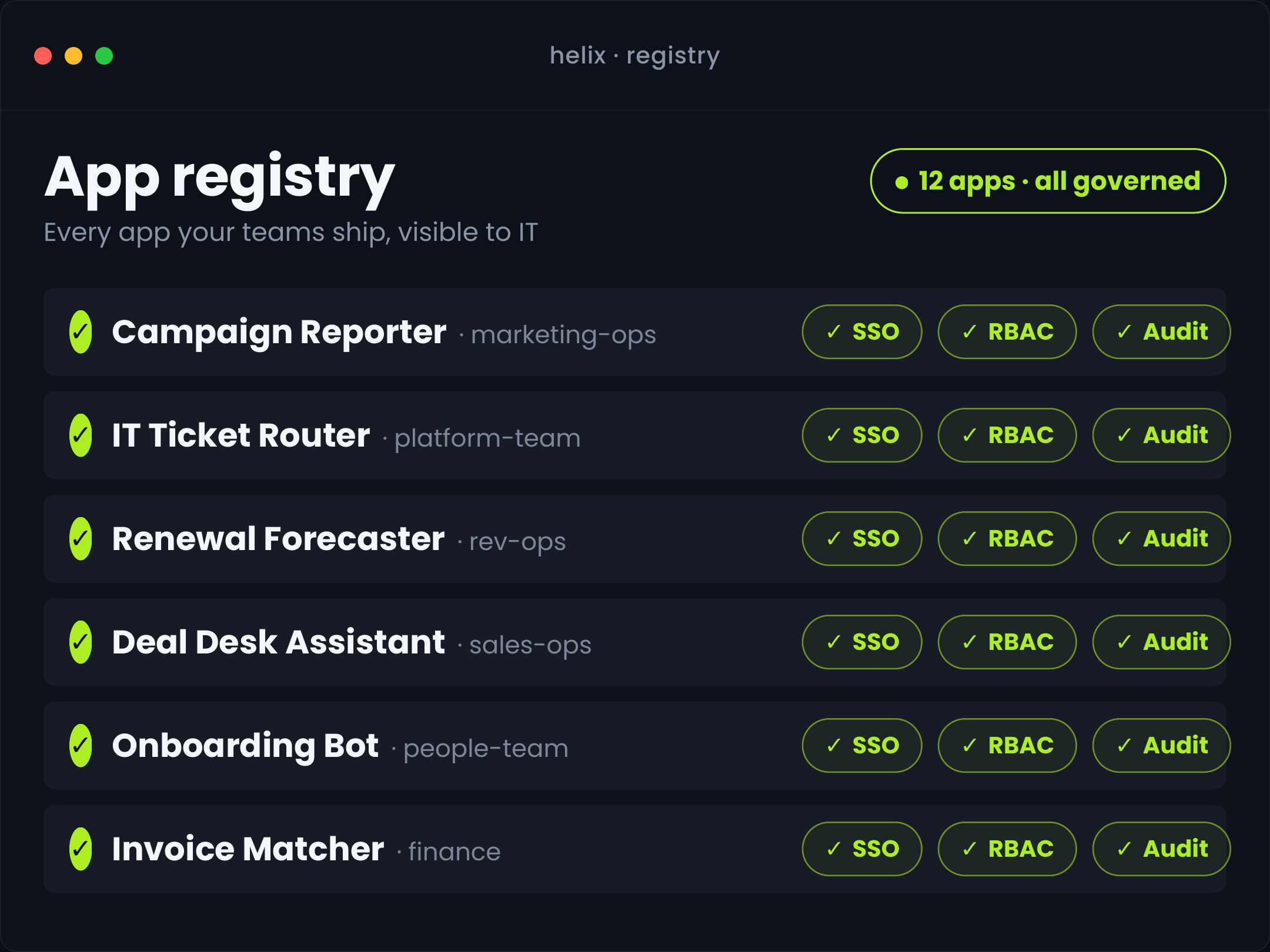
The moment more than a handful of people are building, the estate stops being knowable and the inventory lives in individual memories. The App Registry is where every app deployed through Helix lands automatically, with a named owner and a description, publishable to the workgroup it was built for. It is a marketplace for the people who need the app and a live inventory for the people accountable for it.
The moment more than a handful of people are building, the estate stops being knowable. The inventory lives in individual memories.
Four teams build their own version of the same lookup tool because none of them knew the other three existed.
An app is doing something important and nobody knows who maintains it. When the builder changes team, it becomes nobody's.
Useful apps spread through Slack messages. People who would benefit never hear about them.
Without a registry there is no natural place to require an owner, an approval, or a review before something goes live.
Registration happens on the deploy path rather than as a separate process, so the inventory is complete by construction instead of complete when someone remembers.
Every app deploys with an auto-generated title and description plus a named owner, so accountability is never in question and nothing becomes nobody's.
Builders publish their apps to the people who should have them. Colleagues browse what they are cleared to use rather than hearing about it in a Slack thread.
People see the apps they have access to plus their workgroup's shared apps, so the marketplace stays useful rather than becoming a wall of things nobody can open.
Share an app with the team it was built for, rather than sending a link to whoever happened to ask for it.
Require sign-off for the apps that warrant it and let the rest through by default, so the registry becomes a control point without becoming a queue.
Every app deployed through Helix lands in the registry with a named owner, publishable to the people who should have it. Nothing reaches production without an entry, so the inventory is complete by construction.
A registry someone maintains by hand is out of date the week it is written. This one is a by-product of shipping, so it reflects what is actually running.
Most inventories serve IT alone. This one is also how people find the apps they are cleared to use, which is what keeps it accurate and worth visiting.
When the tool already exists and is findable, the fifth team uses it instead of building a sixth version of the same lookup.
Because everything registers on the way to production, the registry is the obvious place to require an owner or an approval, without adding a step elsewhere.
A team about to build an account lookup searches the registry, finds the one another team shipped last quarter, and uses it instead.
An app whose builder changed team shows up with its ownership gap visible, so it can be reassigned rather than quietly running unmaintained.
Instead of pasting a URL into a channel, a builder publishes to the Marketing workgroup, and the right people find it when they need it.
An approval step is required before that one goes live, while the internal lookup tool a colleague built ships straight through.
Review the registry for apps with no recent activity or a departed owner, and turn off what no longer needs to exist.
When asked what AI-built apps are in production and who owns them, the answer is a view rather than a week of asking teams.
The App Registry is the user-facing marketplace where people discover and launch the apps they are cleared to use. AI Visibility is IT's management and instrumentation plane over everything running. One is for self-serve, the other for oversight.
No. The entry is created as part of deploying, so the registry is complete without anyone maintaining it.
You can, but most teams should not. Approval is best applied where the risk warrants it, so low-risk apps flow through and review effort goes where it matters.
People see the apps they have access to plus their workgroup's shared apps. Discovery follows access rather than exposing everything to everyone.
The app keeps running and the ownership gap is visible in the registry, so it can be reassigned rather than quietly becoming unmaintained.
See how every app that ships through Helix registers itself with a named owner.
Your private status link is on its way to your inbox.